Does Surgical Steel Conduct Electricity? The Surprising Truth
Have you ever looked at a surgical steel piercing or thought about a medical implant and wondered, “Can that conduct electricity?” It’s a great question. You see metal and you think of electricity. The short answer is yes, surgical steel does conduct electricity. But it’s not that simple. It’s not like a copper wire in your wall. Understanding how well it conducts and why is super important, especially when it comes to your health and safety. This guide will explain everything in simple terms, so you’ll know exactly what’s going on with the metal in your body or in a surgeon’s hands.
Table of Contents
- What Makes Metal Conduct Electricity Anyway?
- So, Is Surgical Steel a Good Conductor?
- Why Does This Matter for Medical Implants?
- What About Surgical Tools in the Operating Room?
- Should I Worry About My Surgical Steel Piercing?
- How Does Surgical Steel Compare to Other Metals?
- What Can Change Surgical Steel’s Conductivity?
- Is It a Conductor, Insulator, or Something Else?
- The Big Picture: Why We Choose Surgical Steel
- Frequently Asked Questions
What Makes Metal Conduct Electricity Anyway?
To understand surgical steel, we first need to know how metals work their magic with electricity. Think of a metal object as a tightly packed neighborhood of atoms. In this neighborhood, some tiny particles called free electrons don’t belong to any single atom. They are free to zip around the entire neighborhood. This sea of moving electrons is what makes a metallic bond so strong.
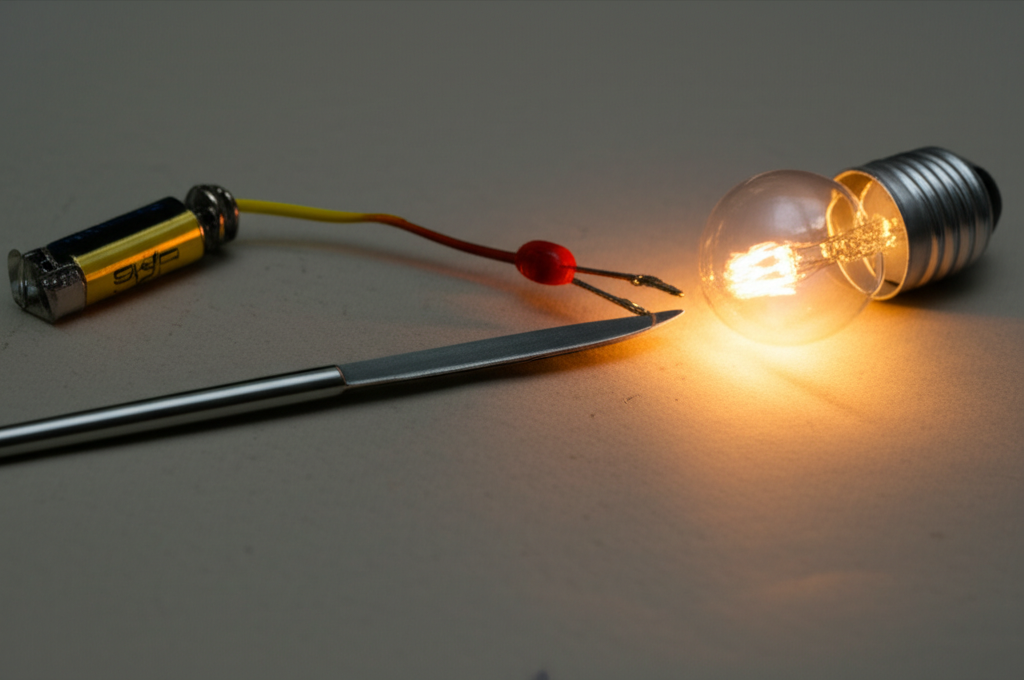
When you connect a metal to something like a battery, you create an electrical current. This is like telling all the free electrons to run in the same direction. The easy movement of these electrons is what we call electrical conductivity. So, if a material has lots of free electrons that can move easily, it’s a good conductor.
Surgical steel is a type of stainless steel, usually grade 316L stainless steel. Its main ingredient is iron, which is a metal full of free electrons. But it’s not just iron. It’s an alloy, a mix of metals. It also contains chromium to fight rust, nickel for shine and strength, and sometimes molybdenum for even more corrosion resistance. Because its main ingredient is iron, surgical steel has those all-important free electrons, which means it can conduct electricity. The specific way its atoms are arranged, called an austenitic stainless steel structure, also helps this electron flow.
So, Is Surgical Steel a Good Conductor?
Okay, we know it conducts electricity. But how well? Is it a superstar conductor like copper, or is it more of a benchwarmer? The truth is, surgical steel is a relatively poor conductor when you compare it to the metals used for wiring.
Imagine electricity is like water flowing through a pipe.
- A great conductor like copper or silver is like a huge, clean fire hose. Water gushes through with almost no effort.
- An insulator like plastic or rubber is like a pipe that’s completely blocked. No water gets through at all.
- Surgical steel is like a long, narrow garden hose with some kinks in it. Water will definitely flow through it, but not very quickly or easily. There’s a lot of resistance.
In science, we measure this “difficulty” with a term called electrical resistivity. High resistivity means it’s hard for electricity to flow. Low resistivity means it’s easy. Surgical steel has a much higher electrical resistance than copper. That’s why we don’t make electrical wires out of it! Its job isn’t to move electricity efficiently. Its job is to be strong, clean, and safe for the human body. The property of thermal conductivity, or how well it conducts heat, is also related to this.
Data Table: Electrical Conductivity & Resistivity of Key Metals
This table shows just how different metals stack up. You can see that surgical steel lets electricity pass, but not nearly as well as copper.
| Material (Typical Grade/Type) | Electrical Conductivity (Siemens per meter @ 20°C) | Electrical Resistivity (micro-ohm-centimeter @ 20°C) | Relative Conductivity (Copper = 100%) | Key Notes & Practical Implications |
|---|---|---|---|---|
| Silver (Pure) | 6.30 × 10⁷ | 1.59 | 108% | The most conductive metal, but expensive. Used in high-end electronics. |
| Copper (Annealed) | 5.96 × 10⁷ | 1.68 | 100% | The standard for electrical wiring due to its excellent conductivity and cost. |
| Gold (Pure) | 4.10 × 10⁷ | 2.44 | 73% | Very conductive and does not corrode. Used for connectors. |
| Aluminum (Pure) | 3.50 × 10⁷ | 2.82 | 61% | Lighter and cheaper than copper, used for overhead power lines. |
| Titanium (Commercially Pure) | 2.38 × 10⁶ | 42.0 | 4% | A biocompatible metal used in implants. It is also a conductor. |
| Surgical Steel (316L) | 1.39 × 10⁶ | 72.0 | ~2.3% | A ferrous metal used in implants and tools. Its conductivity is low but important. |
| Rubber | ~1 × 10⁻¹³ | ~1 × 10²⁰ | ~0% | An excellent insulator. Blocks the flow of electricity completely. |
Note: Values are approximate and can vary based on the specific alloy and temperature.
Why Does This Matter for Medical Implants?
This is where the question gets very serious. If you have a medical implant like a pin in your bone or a dental post, you might worry. What happens during an MRI scan?
The problem is that powerful machines like an MRI (Magnetic Resonance Imaging) use strong magnets and radio waves. You might be scared that a metal implant could get hot or move, causing injury. This is a valid concern, and it’s why doctors are so careful.
The agitation comes from not knowing. Will the scan be safe? Could the implant interfere with another device, like a pacemaker or defibrillator? This uncertainty can be stressful before any medical procedure.
Here’s the solution: Modern surgical steel (like 316L) is designed with this in mind. It is not very magnetic. The main risk in an MRI isn’t from the magnet pulling on it, but from the machine creating small electrical currents in the implant, called eddy currents. Because surgical steel has higher resistance, it doesn’t let these currents get very strong. This means it only heats up a tiny, safe amount. Material scientists work hard to create metals with just the right properties. They understand how factors like composition and structure affect performance, much like how specialized electrical steel laminations are designed to control electrical currents inside motors. Your doctors will always check what kind of implant you have to make sure an MRI is safe for you.
What About Surgical Tools in the Operating Room?
Now let’s flip the story. Sometimes, doctors want to use electricity. In many surgeries, they use a tool for electrocautery or electrosurgery. This is a special pen-like device that uses a high-frequency electrical current to cut tissue or stop bleeding. And guess what the tip is often made of? That’s right, stainless steel.
In this case, its conductivity is a benefit! The tool needs to be a conductor to let the electricity flow precisely where the surgeon wants it. The patient is also placed on a special pad called a grounding pad. This gives the electricity a safe path to travel out of the body, preventing burns. The electrical hazards in operating rooms are very controlled.
So, the moderate conductivity of surgical instruments is actually a key feature that helps surgeons do their job. It’s strong, can be sterilized, and does exactly what’s needed electrically. The design of these tools is a great example of biomedical engineering.
Should I Worry About My Surgical Steel Piercing?
For the millions of people with body jewelry and piercings, this question is personal. Have you ever felt a tiny zap from static electricity when you touch a doorknob? You might worry if your surgical steel jewelry could cause a bigger shock.
It’s easy to imagine a scenario where a current could pass through your current flow through body piercing, which sounds painful! You might also hear stories about needing to remove jewelry for medical scans and wonder why.
The good news is that the risk of a serious electric shock from everyday life is almost zero. Surgical steel isn’t conductive enough to attract electricity or put you in danger from household items. You might feel a tiny static zap through it, but it’s harmless.
The real reason you’re asked to remove piercing jewelry before an MRI or surgery is for safety. In an MRI, even a small piece of metal can heat up. In a surgery using electrocautery, the electrical current could accidentally travel through your jewelry and cause a burn far from where the surgeon is working. So, it’s always best to follow medical advice and remove any body jewelry before these procedures.
How Does Surgical Steel Compare to Other Metals?
Surgical steel isn’t the only metal used in the body. Titanium is another very common one, especially for dental implants and joint replacements. Titanium also conducts electricity, and its conductivity is pretty similar to surgical steel—both are much less conductive than copper. The choice between them often depends on other things, like weight (titanium is lighter) and how the body reacts to them (biocompatibility).
A more interesting issue is something called galvanic corrosion. This can happen if two different types of metals are placed next to each other inside the body. Your body fluids can act like battery acid, creating a tiny electrical circuit between the metals. This can cause one of the metals to break down over time. This is why doctors are very careful to use the same or compatible metals, like those meeting ASTM F138 or ISO 5832 standards, for all parts of an implant.
What Can Change Surgical Steel’s Conductivity?
The electrical properties of surgical steel aren’t set in stone. A few things can change them slightly:
- Temperature: For most metals, as they get hotter, their electrical resistance goes up. This means they become slightly worse conductors when hot.
- Alloying Elements: Tiny changes in the recipe—a little more or less chromium or nickel—can affect the resistivity of surgical stainless steel. Manufacturers control this very carefully.
- Surface Layer: Surgical steel doesn’t rust because it forms an invisible, super-thin protective layer called a passivation layer. This layer is made of chromium oxide and is actually an insulator! However, it’s so thin that it doesn’t stop the whole piece of metal from conducting electricity.
Is It a Conductor, Insulator, or Something Else?
Let’s clear this up once and for all. In the world of materials, there are three main groups:
Surgical steel is 100% a conductor. It is not an insulator and it is not a semiconductor. It’s a metal, and metals conduct electricity. It’s just not a very efficient one, which, as we’ve seen, can be a good thing for its special jobs.
The Big Picture: Why We Choose Surgical Steel
So, if surgical steel is not a great conductor, why do we use it for so many important things? Because its value isn’t just in one property. It’s the amazing combination of all its features that makes it a champion material.
Imagine you’re building something complex, where different parts need to work together perfectly. You wouldn’t use the same material for everything. In an electric motor, for example, you need highly conductive copper for the windings and special metals for the parts like the stator and rotor. Each material is chosen because it has the best balance of properties for its specific job.
Surgical steel is chosen for implants and tools for this very reason. It has the perfect mix:
- Strength: It’s tough and doesn’t break easily.
- Corrosion Resistance: It won’t rust inside the human body.
- Biocompatibility: The body accepts it without causing a bad reaction.
- Moderate Conductivity: Its electrical properties are predictable and safe for use with medical equipment.
Its higher resistance makes it safer in MRI machines and perfect for tools like electrocautery scalpels. It strikes a balance that other materials can’t.
Frequently Asked Questions (FAQ)
Can you get an electric shock from surgical steel?
It’s very unlikely. For you to get a shock, the metal would need to complete a circuit with a power source. Everyday static electricity might give you a tiny zap, but it is harmless.
Does surgical steel interfere with a pacemaker?
Medical devices like pacemakers are carefully designed and shielded. While any conductive material can potentially cause electromagnetic interference (EMI), implants made from modern surgical steel are generally considered safe. However, patients should always inform their doctors about all implants before any procedure.
Is all stainless steel the same?
No. There are many types. 316L is a specific grade called “surgical steel” because its low carbon content and added molybdenum make it very resistant to corrosion, even in the salty environment of the human body. Other types, like the one in your kitchen sink, might not be as safe for implants. The quality and type matter, just as they do when choosing the right materials for creating efficient motor core laminations.
The Bottom Line
Let’s wrap it up. Here are the most important things to remember about surgical steel and electricity:
- Yes, it Conducts: Surgical steel is a metal, so it definitely conducts electricity.
- It’s a “Poor” Conductor: Compared to copper, its resistance is very high. This means it doesn’t let electricity flow easily.
- This is Often a Good Thing: Its low conductivity makes it safer for medical implants in MRI machines and useful for special surgical tools.
- It’s All About Balance: Surgical steel is used because it’s strong, clean, safe for the body, and has predictable electrical properties.
- Safety First: Always remove surgical steel jewelry before medical procedures like MRIs or surgery to avoid any risk of burns or interference.