How Long Do Trolling Motor Batteries Last? A Comprehensive Guide to Runtime & Lifespan
Every angler knows the feeling. You’re on the water, the bite is hot, and you’re quietly maneuvering your boat into the perfect position. Then, silence. Your trolling motor whirs to a stop, the power indicator is blinking red, and the wind starts pushing you off your spot. A dead battery can cut a great day of fishing short. If you’ve ever found yourself wondering just how long your trolling motor battery should last—or why it died so quickly—you’re in the right place.
The truth is, there’s no single, simple answer. The question “How long do trolling motor batteries last?” really has two parts: How long will it run on a single charge (runtime), and how many years will it last before you need to replace it (lifespan)?
The answer to both is, “It depends.” But don’t worry. This guide will break down all the critical factors, from battery chemistry to your habits on the water, so you can stop guessing. We’ll give you the tools to understand your power system, maximize your time on the water, and make an informed decision when it’s time to buy a new battery.
What We’ll Cover
- Understanding Trolling Motor Battery Runtime (Per Charge): Learn the key factors and how to calculate your expected time on the water.
- Understanding Trolling Motor Battery Lifespan (Overall Years): Discover how long different battery types last and what causes them to fail.
- How to Maximize Your Battery’s Life and Runtime: Get actionable tips for charging, usage, and maintenance.
- Trolling Motor Battery FAQs: Quick answers to the most common questions.
Understanding Trolling Motor Battery Runtime (Per Charge)
Runtime is how many hours you can run your trolling motor before the battery is depleted. Think of it as the size of your boat’s fuel tank for the day. This can range from just a couple of hours to a full day or more, depending on a handful of crucial variables.
The Short Answer: It Depends! (Key Factors)
If you’re looking for a quick number, you’ll be disappointed. Runtime is a dynamic calculation that changes based on how you use your gear. Here are the main players that determine how long you’ll stay powered up.
- Battery Capacity (Amp-Hours – Ah): This is the single most important factor. Amp-hours are the direct measure of a battery’s energy storage. Think of it exactly like a gas tank: a 100Ah battery holds twice the energy of a 50Ah battery, just as a 20-gallon tank holds twice the fuel of a 10-gallon tank. More Ah equals more potential runtime.
- Trolling Motor Power Draw (Amps): Your motor’s thrust rating (e.g., 55 lbs) tells you its maximum power, but the real factor is its amp draw. This is how much electrical current the motor pulls from the battery. Running at full throttle might draw 50 amps, while slow trolling on a calm day might only draw 10 amps. The lower the amp draw, the longer your battery will last.
- Battery Type (Lead-Acid vs. Lithium): Not all amp-hours are created equal. A 100Ah lithium battery will provide significantly more runtime than a 100Ah lead-acid battery. This is because lead-acid batteries suffer voltage drops under heavy load and you can only safely use about 50% of their capacity. Lithium batteries maintain a steady voltage and allow you to use 80-100% of their rated capacity.
- Boat Size & Water Conditions: Pushing a heavy boat into strong wind and current is like driving your truck uphill with a heavy load—it demands more power. A lighter boat on a calm day requires far less energy, meaning a lower amp draw and much longer runtime.
- Your Usage Patterns: Do you run at full speed from spot to spot or do you use your motor for subtle adjustments? Constantly running at higher speeds will drain your battery exponentially faster than using it intermittently at lower speeds.
Calculating Trolling Motor Battery Runtime
Want to get a ballpark estimate? You can do it with some simple math. You’ll need two key numbers: your battery’s Amp-hour (Ah) rating and your motor’s average Amp Draw.
The basic formula is: Runtime (in hours) = Battery Capacity (Ah) / Amp Draw (Amps)
But wait, there’s a catch! As we mentioned, you can’t use 100% of a lead-acid battery’s capacity without damaging it and drastically shortening its lifespan. This is where Depth of Discharge (DoD) comes in.
- For Lead-Acid (Flooded, AGM, Gel) batteries, you should only plan on using 50% of the capacity.
- For Lithium (LiFePO4) batteries, you can safely use 80-100% of the capacity.
So, the more accurate formula looks like this:
Realistic Runtime = (Battery Capacity (Ah) x Usable DoD %) / Amp Draw (Amps)
Example Calculation: 55 lb Thrust Motor
Let’s say you have a common 55 lb thrust motor. At medium speed, it might draw an average of 20 amps. You’re trying to choose between a 100Ah AGM battery and a 100Ah Lithium battery.
- AGM Battery: (100 Ah x 0.50) / 20 Amps = 2.5 hours of runtime
- Lithium Battery: (100 Ah x 0.90) / 20 Amps = 4.5 hours of runtime
As you can see, even with the same Ah rating, the usable capacity of lithium provides nearly double the runtime in this real-world scenario.
Average Runtime Estimates by Battery Type & Capacity
Here are some general estimates to give you an idea. Remember, these are based on a moderate, continuous amp draw and will vary wildly with speed, wind, and current.
| Scenario (100Ah Battery) | Lead-Acid/AGM/Gel (50% DoD) | Lithium (LiFePO4) (90% DoD) |
|---|---|---|
| Slow Trolling (~10A Draw) | ~5 hours | ~9 hours |
| Medium Speed (~20A Draw) | ~2.5 hours | ~4.5 hours |
| Full Throttle (~50A Draw) | ~1 hour | ~1.8 hours |
Understanding Trolling Motor Battery Lifespan (Overall Years)
Beyond a single day’s runtime, you also need to know how many seasons you can expect your battery to last. A battery’s total lifespan is measured in years or, more accurately, in charge cycles. A cycle is one full discharge and recharge.
Expected Lifespan by Battery Chemistry
The technology inside your battery is the biggest predictor of its overall lifespan.
- Flooded Lead-Acid: These are the traditional, budget-friendly batteries. With proper maintenance, you can expect 2-4 years or about 200-400 charge cycles.
- AGM (Absorbed Glass Mat): A step up from flooded, AGMs are sealed and maintenance-free. They typically last 3-6 years or 300-700 cycles.
- Gel: Gel batteries offer good performance and are very vibration-resistant, but they require specific charging profiles. They generally last 3-7 years or 400-800 cycles.
- Lithium Iron Phosphate (LiFePO4): The king of longevity. Lithium is a significant upfront investment but blows everything else away in lifespan. You can expect 8-10+ years and an incredible 2,000-5,000+ charge cycles. For a serious angler who fishes often, a lithium battery can actually be cheaper in the long run.
Key Factors Influencing Battery Lifespan
You can have the best battery in the world, but if you treat it poorly, it won’t last. Here are the factors that can make or break your battery’s lifespan.
Signs Your Trolling Motor Battery is Failing
Is your battery on its last legs? Here are some tell-tale signs:
- Significantly Reduced Runtime: The most obvious sign. If you used to get 6 hours and now you only get 2, your battery’s capacity has faded.
- It Won’t Hold a Charge: You take it off the charger and it reads a full charge, but a day later it’s nearly dead without even being used.
- Charges Too Quickly or Too Slowly: If your smart charger used to take 8 hours and now finishes in 2, it’s a sign the battery can no longer accept a full charge.
- Physical Damage: Any swelling, bulging, or leaking from a lead-acid battery means it’s time to replace it immediately and safely.
How to Maximize Your Trolling Motor Battery’s Life and Runtime
You’ve invested in a good battery; now it’s time to protect that investment. Following these best practices will squeeze every last hour of runtime and every possible year of lifespan out of your system.
Best Practices for Charging
Optimizing Usage for Longer Runtime
Proper Maintenance and Storage
Trolling Motor Battery FAQs
Can I use a car battery for a trolling motor?
No, you shouldn’t. A car battery is a “starting” battery, designed to deliver a massive burst of power for a few seconds to crank an engine. A trolling motor needs a “deep cycle” battery, which is designed to deliver a steady amount of power over many hours. Using a car battery will leave you stranded and will destroy the battery in short order.
Is it worth upgrading to a lithium trolling motor battery?
For casual anglers who go out a few times a year, a quality AGM battery is often sufficient. However, for serious tournament anglers or anyone who fishes frequently and demands long runtimes and reliability, the answer is an emphatic yes. The massive increase in lifespan (5x or more), usable capacity, consistent power, and significant weight savings often justify the high initial cost over the long term. They provide the sustained power needed for modern, high-efficiency motors, some of which feature an advanced bldc stator core design.
How much trolling motor battery do I need?
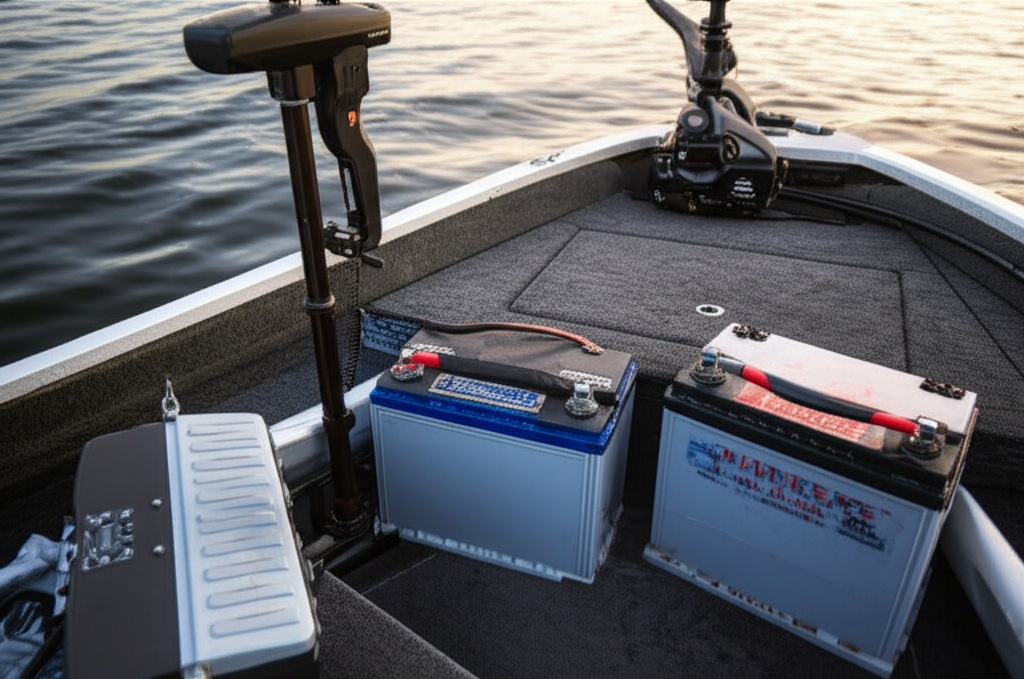
A good rule of thumb is to have at least a 100Ah battery for any serious fishing application. For 12V systems, a single Group 27 or Group 31 battery is common. For 24V or 36V systems, you’ll need two or three batteries, respectively. If you fish long days, in heavy current, or have a heavy boat, consider larger capacity batteries or making the jump to lithium.
How do I know when my trolling motor battery is fully charged?
The best way is to trust your multi-stage smart charger; it will switch to a “float” or “maintain” mode when the battery is full. You can also check the voltage with a multimeter after the battery has been off the charger and resting for a few hours. A fully charged 12V lead-acid battery will read around 12.7V or higher, while a fully charged LiFePO4 battery will read around 13.4V-13.6V.
What’s the best battery size for a 55lb thrust trolling motor?
For a 12V, 55lb thrust motor, a Group 31 deep cycle battery with a capacity of at least 100Ah is the recommended minimum for reliable, all-day performance.
Conclusion: Making Your Trolling Motor Battery Last
As you can see, the longevity of your trolling motor battery is in your hands. It’s not just about the specs on the label; it’s about the synergy between the battery chemistry, your equipment, and your habits. The power to run your motor ultimately comes from the complex interaction of magnetic fields and electricity within the motor core laminations, and the battery is the vital fuel for that process.
Let’s boil it all down to a few key takeaways:
- Choose the Right Tool for the Job: Match your battery type (AGM, Lithium) and capacity (Ah) to your fishing style, boat size, and budget.
- Runtime is a Calculation, Not a Guess: Understand that your speed, the weather, and your boat’s weight are constantly affecting your battery’s drain rate.
- Charging is Everything: A high-quality smart charger is the best investment you can make for your battery’s long-term health. Charge it right, and charge it often.
- Don’t Abuse the Capacity: Respect the 50% depth-of-discharge rule for lead-acid batteries. Running them to empty is the fastest way to the recycling center.
Armed with this knowledge, you’re no longer just a user; you’re a power system manager. You can confidently choose the right battery, predict its performance, and take the simple steps needed to maximize its life. That means less time worrying about power and more time enjoying quiet, reliable control on the water.