How Long Is Texas Motor Speedway? The Full Story Behind the 1.5-Mile Beast
Have you ever watched a race at Texas Motor Speedway and just wondered, “How long is that track, really?” It’s a simple question, but the answer is anything but. Just knowing the number is like knowing the first note of a song—you’re missing the whole epic melody. You see the cars, you hear the roar, but you don’t feel the strategy, the danger, and the pure genius that goes into conquering this beast of a track.
Well, you’ve come to the right place. I’m going to give you the simple answer, and then I’m going to pull back the curtain. We’ll explore every turn, every steep bank, and every long straightaway. You’ll learn not just the length of the track but why that length makes it one of the most thrilling venues in all of motorsports. Get ready to understand the “Great American Speedway” like never before.
Table of Contents
- So, What’s the Official Length of the Track?
- What Makes the Track’s Shape So Special?
- Why Is the Banking Such a Big Deal?
- How Does This 1.5-Mile Length Affect NASCAR Races?
- What About IndyCar? Is It Different for Them?
- Are There Other Tracks at Texas Motor Speedway?
- How Does TMS Compare to Other Big Racetracks?
- Has the Track’s Layout Always Been the Same?
- Your Top Questions About TMS Answered
- The Final Lap: Why TMS is More Than Just a Number
So, What’s the Official Length of the Track?
Let’s get right to it. The main oval at Texas Motor Speedway (TMS) is 1.5 miles long.
There it is. The simple answer. But that number is the key that unlocks everything else. In the world of auto racing, a 1.5-mile track is known as an “intermediate” track. It’s the sweet spot—not a giant superspeedway like Daytona or Talladega and not a tiny short track like Martinsville. This length creates a unique kind of racing that demands both raw speed and incredible skill.
This famous Fort Worth race track, a crown jewel built by the legendary O. Bruton Smith and his company Speedway Motorsports (SMI), was designed from day one to be a challenge. When you hear commentators talk about “cookie-cutter” 1.5-mile tracks, they’re often comparing them to TMS. This track, located in the massive Dallas-Fort Worth Metroplex, has a personality all its own, and its 1.5-mile distance is just the beginning of the story.
What Makes the Track’s Shape So Special?
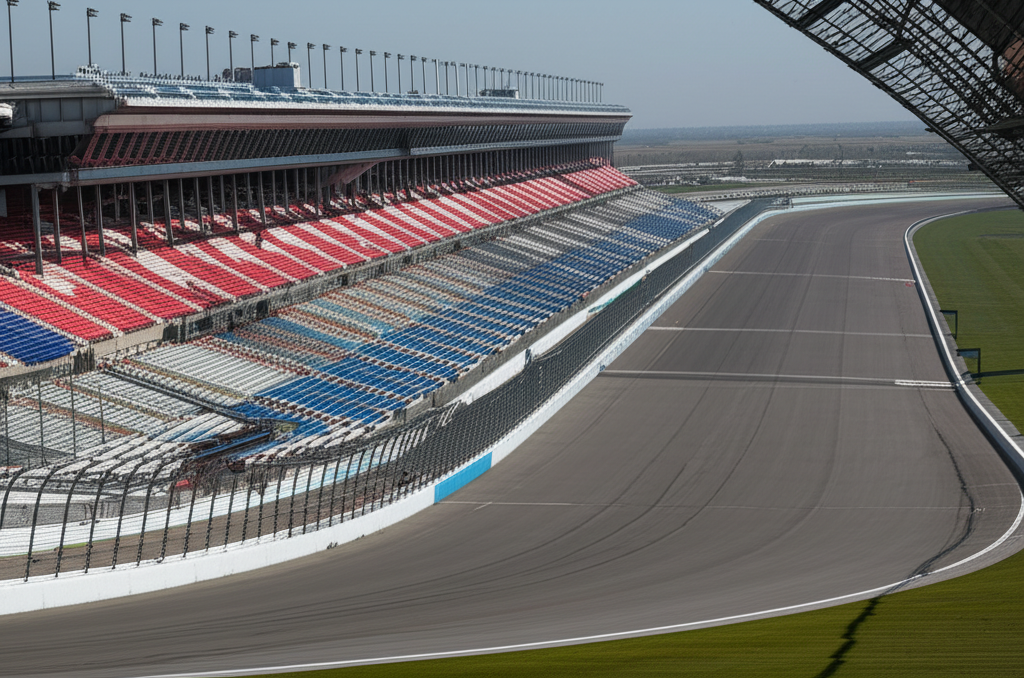
Ever noticed that the front part of the track, where the fans and pit road are, looks different from the back? That’s because Texas Motor Speedway is a D-shaped oval. Imagine a perfect oval, then stretch one side out into a straight line. That’s the shape of TMS. This design isn’t just for looks; it has a huge impact on the race.
The long, straight frontstretch gives fans in the grandstands an amazing view as the cars thunder past. It’s also where you’ll find pit road, which is a critical part of race strategy. The backstretch is a bit more traditional, a gentle curve that slingshots cars into the challenging Turns 3 and 4. This unique D-shaped oval length at TMS is a big reason why races here are so unpredictable.
The track width is also super important. In the turns, it’s about 60 feet wide, which gives drivers room to race side-by-side. On the straightaways, it’s a little narrower at 58 feet. This width allows for multiple racing grooves, meaning drivers can search for the fastest way around the track, creating more passing and excitement for everyone watching. It’s a key part of the Texas Motor Speedway track specifications that make it a premier facility.
Why Is the Banking Such a Big Deal?
If you’ve ever walked down a steep hill, you know what banking feels like. Now, imagine driving on that hill at nearly 200 miles per hour. That’s what banking is on a racetrack, and at Texas Motor Speedway, it’s extreme. The banking is the secret to the incredible speeds you see.
Here’s the problem for drivers: how do you go that fast into a corner without flying off the track? The solution is to tilt the track. The banking pushes the cars down, sticking them to the asphalt like glue and allowing them to carry tremendous speed through the turns. But here’s the twist at TMS: the banking isn’t the same all the way around!
- Turns 1 & 2: These turns have 20 degrees of banking. That’s steep!
- Turns 3 & 4: This side is even steeper, with 24 degrees of banking. This is where drivers really have to hang on as they prepare to blast down the frontstretch.
- Frontstretch & Backstretch: The straightaways have just 5 degrees of banking, mostly for drainage.
This difference in banking makes setting up the race car a nightmare for teams but a dream for fans. A car that handles perfectly in Turns 1 and 2 might be a real handful in Turns 3 and 4. It forces drivers to be on their toes for every single one of the hundreds of laps in a race. It’s this engineering of the TMS track that creates so much drama.
How Does This 1.5-Mile Length Affect NASCAR Races?
For the NASCAR Cup Series, 1.5-mile tracks like TMS are the bread and butter of the schedule. These are the tracks where championships are often won or lost. A typical Cup Series race here, like the Autotrader EchoPark Automotive 400, might be 400 miles long. That means drivers have to circle the 1.5-mile track over 260 times!
This distance creates a huge need for strategy. It’s not just about who has the fastest car; it’s about who plays the game the smartest.
- Tire Wear: The high speeds and rough track surface wear out tires quickly. Teams have to plan their pit stops perfectly to get fresh Goodyear tires at the right moment.
- Fuel Mileage: Can a driver save enough fuel to make it to the end without an extra pit stop? Sometimes, the winner is the one who sips gas the best, not the one who is fastest.
- Race Car Setup: The car has to be perfect. The powerful engines in these stock cars, with their intricate systems built from quality motor core laminations, must be tuned to handle the track’s unique challenges.
The racing is intense. The D-shape and high banking lead to blistering average speeds. Cars get bunched up on restarts, leading to close-quarters, heart-stopping action. A single mistake during a pit stop, which happens on the long pit road with 45 stalls, can ruin a driver’s whole day. This is why a win at Texas Motor Speedway is so special.
What About IndyCar? Is It Different for Them?
If NASCAR at TMS is a high-speed chess match, then the NTT IndyCar Series is a rocket-powered blur. The open-wheel cars of IndyCar are lighter and have less drag than NASCAR stock cars, which means one thing: unbelievable speed. The IndyCar Series TMS length presents a totally different challenge.
When IndyCar comes to Fort Worth, the average speeds are mind-boggling, often well over 200 miles per hour. I remember watching races where the cars looked like fighter jets flying in formation. The slipstream, or draft, is incredibly powerful here. One car can tuck in behind another and get pulled along, saving fuel and setting up a thrilling slingshot pass down the straightaway.
The high banking is even more critical for these cars. It allows them to maintain their momentum through the turns without scrubbing off much speed. For years, the IndyCar race at TMS was one of the fastest and most dangerous on the schedule, a true test of bravery and skill for the world’s best open-wheel drivers. It shows just how versatile this 1.5-mile layout really is, able to host two completely different styles of racing at the highest level.
Are There Other Tracks at Texas Motor Speedway?
You might think the giant 1.5-mile oval is all there is, but the facility is huge—we’re talking about a property covering around 1,500 acres! Tucked inside and around the main speedway are several other tracks for different kinds of racing.
First, there’s The Dirt Track at Texas Motor Speedway. It’s a 0.4-mile high-banked dirt oval located right next to the big track. This is where you’ll see sprint cars, late models, and other grassroots racing series kicking up dirt and sliding sideways. It’s a completely different kind of show and a fan favorite.
There’s also a road course configuration at TMS. By using parts of the oval and a winding infield section, the speedway can transform into a challenging road course up to 2.3 miles long. While it doesn’t host major professional races, it’s used for driving schools, club racing, and testing. It’s a place where you can learn to drive a high-performance car and feel like a real pro. The facility even has a smaller kart track, ensuring there is a racing experience for everyone.
How Does TMS Compare to Other Big Racetracks?
It’s always fun to compare tracks. So, how does the length of Texas Motor Speedway stack up against other famous NASCAR and IndyCar venues?
- Compared to Other Intermediate Tracks: TMS is in the same family as places like Charlotte Motor Speedway, Las Vegas Motor Speedway, and Kansas Speedway. They are all 1.5 miles long. However, TMS’s unique banking and shape give it a distinct feel. Many drivers say it’s one of the most challenging of the bunch.
- Compared to Superspeedways: It’s much smaller than the giants of the sport. Daytona International Speedway is 2.5 miles long, and Talladega Superspeedway is even bigger at 2.66 miles. The racing at those tracks is all about pack drafting, while TMS requires a mix of drafting and car handling.
- Compared to Short Tracks: On the other end, TMS is huge compared to a short track. Bristol Motor Speedway is only about half a mile long, and Martinsville Speedway is just a little over that. Racing there is like a boxing match in a phone booth—lots of bumping and banging. TMS gives drivers much more room to breathe, but at much higher speeds.
This comparison of TMS to other speedways shows why it’s such a perfect test. It has the speed of a big track and the importance of handling you see at a smaller one.
Has the Track’s Layout Always Been the Same?
For the most part, the original TMS track length of 1.5 miles has stayed the same since it opened in 1997. However, the track has gone through some major changes to improve the racing and make it safer. The biggest renovation happened in 2017.
The problem was that Turns 1 and 2 had a tendency to hold water after it rained, which caused long delays. It was also very challenging for drivers, with a tricky transition off the frontstretch. So, the track owners decided to make a big change.
- They completely re-paved the entire track surface.
- They re-profiled Turns 1 and 2, reducing the banking from 24 degrees down to 20 degrees and making the turn wider.
- They added an extensive drainage system to help the track dry much faster.
These changes had a huge impact. The new pavement made the track incredibly fast. The changes to Turns 1 and 2 made that end of the speedway completely different, forcing teams and drivers to throw out their old notes and start from scratch. The relationship between the stator and rotor in the engines had to be recalibrated to deliver power differently on the new surface. It was a bold move that continues to shape the racing we see at TMS today.
Your Top Questions About TMS Answered
I get asked a lot of questions about this amazing place. Let’s tackle some of the most common ones.
Q: Is Texas Motor Speedway bigger than Daytona?
A: No, it isn’t. The track length at TMS is 1.5 miles, while Daytona is a full 2.5 miles long. Daytona is a superspeedway, while TMS is an intermediate track.
Q: What is the fastest lap at TMS?
A: Track records are always being challenged, but the fastest official lap was set by IndyCar driver Tony Kanaan’s qualifying run at over 220 mph! In NASCAR, qualifying speeds often approach 200 mph.
Q: How many laps is a NASCAR race at TMS?
A: It depends on the race distance. For a 500-mile race (a distance they used to run), it would be 334 laps. For the current 400-mile race, it’s 267 laps.
Q: Does TMS have a road course?
A: Yes, it does! The speedway has an interior road course layout that can be used for various events and driving experiences, separate from the main oval.
Q: What is the banking at TMS?
A: The banking is 20 degrees in Turns 1 and 2, and 24 degrees in Turns 3 and 4, with 5 degrees on the straightaways. It’s this high banking that allows for such incredible speeds.
The Final Lap: Why TMS is More Than Just a Number
So, how long is Texas Motor Speedway? It’s 1.5 miles. But as you’ve seen, it’s so much more than that. It’s a puzzle of high-banked turns, a D-shaped challenge, and a battleground for strategy and speed. From the roar of the NASCAR Cup Series to the breathtaking velocity of the NTT IndyCar Series, this track has earned its place as a titan of motorsports.
It’s a place where you can see Big Hoss TV, the world’s largest HD video board. It’s a place where history has been made and champions have been crowned. Every single detail, from the width of the track to the angle of the banking, was designed to create thrilling entertainment. The next time you watch a race from Fort Worth, you won’t just see cars going around a 1.5-mile track. You’ll see a masterpiece of racing engineering at work.
Key Things to Remember
- The Main Track: Texas Motor Speedway’s main oval is a 1.5-mile, D-shaped track.
- The Banking: The turns are very steep, with 20 degrees in Turns 1 & 2 and 24 degrees in Turns 3 & 4.
- The Racing: It’s known as an “intermediate” track, perfect for the high-speed, strategic racing of both NASCAR and IndyCar.
- More Than an Oval: The facility also includes a 0.4-mile dirt track and an infield road course.
- A Unique Challenge: The combination of its shape, banking, and length makes TMS one of the most demanding and exciting tracks on the racing calendar.