How to Ohm a Motor: A Step-by-Step Guide I Use to Diagnose Winding Health
Table of contents
- Introduction: Why I ohm motors before anything else
- What “ohming a motor” really means
- Tools and safety I never skip
- Pre-test steps: Set yourself up for clean readings
- How I ohm a single-phase motor
- How I ohm a three-phase motor
- How I interpret the numbers
- Advanced tests that save me from guesswork
- Special notes on DC, BLDC, stepper, and servo motors
- Common problems I diagnose with an ohmmeter
- Real-world examples and what they taught me
- Maintenance, ROI, and when to call a pro
- Final checklist and quick answers
Introduction: Why I ohm motors before anything else
When a motor acts up I grab my multimeter first. Not a wrench. Not a new capacitor. I ohm the windings. It’s fast. It’s safe when you do it right. It tells me if I’m dealing with a healthy stator or if I should stop and plan a repair. In my experience this simple resistance check prevents wild goose chases and parts darts.
I’ve used winding resistance tests on HVAC fan motors, pump motors, three-phase compressors, and even small brushless motors. The method stays the same. Kill the power. Isolate the motor. Take clear resistance measurements. Then interpret what those numbers mean. You can call it a “motor winding resistance test” or a “continuity test on an electric motor.” Either way you’re reading the electrical health of the windings.
What “ohming a motor” really means
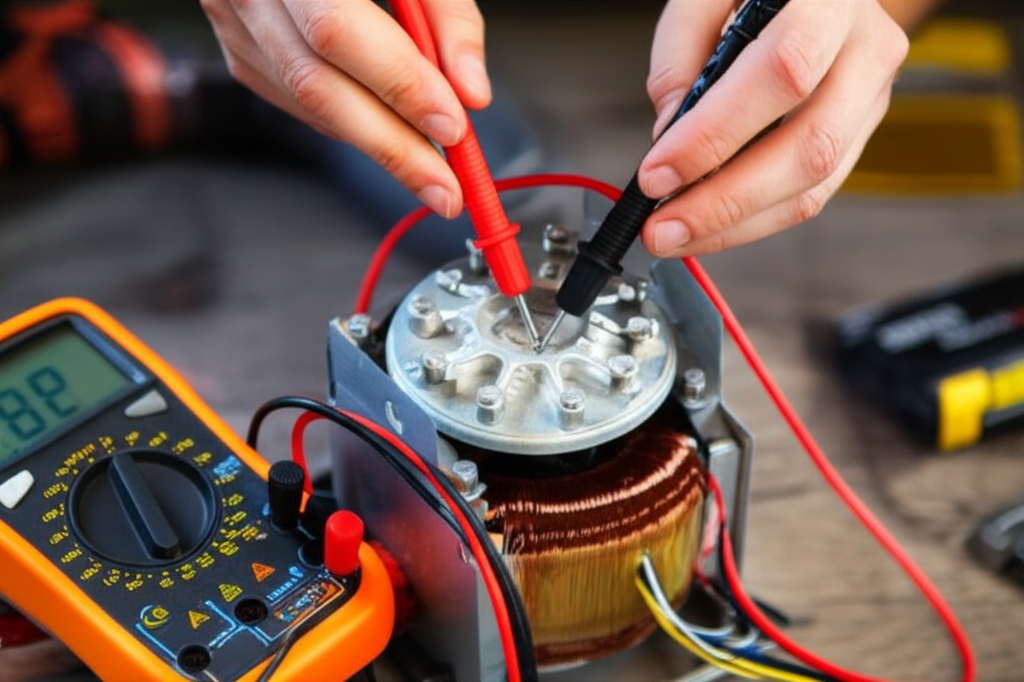
“Ohming a motor” means measuring the resistance of its windings with a multimeter set to ohms. You check:
- Winding-to-winding resistance (phase-to-phase on three-phase motors or run/start/common on single-phase)
- Winding-to-frame resistance to identify a ground fault
You won’t get motor performance from this test. You won’t see how the rotor behaves under load. You will spot open circuits, shorts, and ground faults. You can also catch unbalanced windings that hint at insulation damage or a bad connection.
If you want a picture, think of the windings as hoses. Ohming tells you if a hose is open, clogged, or leaking to ground. It doesn’t tell you how strong the pump is. It tells you if the hose can even hold pressure.
Tools and safety I never skip
Before you touch a terminal, slow down and gear up. I know the job feels routine. That’s when people get hurt.
Required tools:
- Digital multimeter with an ohms function (DMM). If you have an analog multimeter it can work too. A DMM reads low resistances more easily.
- PPE: safety glasses and insulated gloves
- Insulated screwdrivers and nut drivers
- Marker or labels for leads
- Cleaning brush or contact cleaner
- A dedicated voltage tester to verify zero voltage
- Optional but handy: clamp meter for current draw analysis later, megohmmeter (Megger) for insulation resistance tests, and a Kelvin lead adapter for low-ohm accuracy
Safety steps I treat as non-negotiable:
- Lockout/Tagout (LOTO). Disconnect power at the breaker or MCC. Lock it. Tag it. Verify the right circuit.
- Verify zero voltage with a tester at the motor terminals. Don’t trust the breaker position. Trust the meter.
- Discharge capacitors on single-phase motors safely. Use a resistor rated for the job. Don’t dead short a capacitor with a screwdriver. That’s not a badge of honor.
- Isolate VFD-fed motors. VFDs hold DC bus energy that can bite. Wait for the DC bus to bleed off and confirm zero.
- Wear PPE. Electricity doesn’t care how experienced you are.
Pre-test steps: Set yourself up for clean readings
Good measurements start before you touch the meter.
- Isolate the motor. Disconnect it from the power supply and any control circuits. Remove jumpers or contactor connections. Pull motor leads into the clear.
- Access the terminal box. Open the cover and note how leads are tied (star/wye, delta, series, or parallel).
- Label everything. I label T1, T2, T3 on three-phase motors and C, R, S on single-phase. If you’re not sure which is which you can identify them by resistance relationships.
- Clean the connections. Oxidation causes bad readings. I use contact cleaner and a light brush on terminals.
- Identify motor type. Single-phase vs three-phase changes what you expect. DC motors, BLDC, and stepper motors add nuance too.
- Zero your meter leads if your DMM supports a relative/zero function. On low resistances that matters.
How I ohm a single-phase motor
Single-phase motors usually have two windings: run and start. Many have a capacitor in series with the start winding. The three common leads in the terminal box are:
- C (Common)
- R (Run)
- S (Start)
Here’s how I test them:
Interpreting single-phase readings I trust:
- Start > Run. The start winding has more turns of finer wire. More length means more resistance.
- R-S equals the sum of the other two. This is the best quick cross-check.
- OL or infinity between any expected pair means an open winding or broken lead.
- A very low reading between leads can hint at a shorted winding or misidentified terminals.
- Any continuity from a winding to the frame means a ground fault. Stop and plan an insulation test with a megohmmeter.
Tip: If a capacitor stays in the circuit your readings won’t make sense. Always pull one leg of the capacitor off before you measure the winding.
What about expected ohms values? It depends on motor size and type. Tiny fan motors show several tens of ohms. Larger single-phase motors show fractions of an ohm to a few ohms on the run winding. I focus on relationships rather than absolute numbers.
How I ohm a three-phase motor
Three-phase motors show three identical windings. You’ll see terminals labeled T1, T2, T3 or U, V, W. Sometimes there are six or nine leads for star/delta options. My approach stays the same.
What I expect:
- All three phase-to-phase readings should match closely. A healthy motor usually sits within about 5% between phases. I tighten that to 2–3% on critical equipment.
- Any OL reading between a pair means an open in that phase.
- Any reading that’s significantly lower than the others hints at a shorted or partially shorted winding.
- Any continuity to ground is a red flag. That’s a ground fault or moisture ingress.
A quick example. I once read 0.9 Ω, 0.9 Ω, and 0.5 Ω on a pump motor. That low leg was the smoking gun. The motor still tried to run so the overload tripped. After teardown we found heat darkening on one section of the stator and a damaged turn.
Note on star/delta. If the motor is still strapped in star or delta while paralleled for a specific voltage you must measure across the correct lead pairs. If you’re unsure pull jumpers to isolate each winding then test end-to-end.
How I interpret the numbers
Numbers don’t fix motors. Decisions do. Here’s how I turn readings into decisions.
- Normal readings
- Three-phase: all pairs match closely. No continuity to ground.
- Single-phase: C-R is lower than C-S. R-S ≈ C-R + C-S. No ground continuity.
- Open winding
- You see OL on a pair that should read resistance. On single-phase that often means a thermal overload protector is open or a broken lead at the stator. On three-phase it’s usually a broken connection or a blown winding.
- Short circuit (phase-to-phase or turn-to-turn)
- One reading drops well below the others. This can be a hard short or internal insulation damage. The motor might spin then trip a breaker or cook under load.
- Ground fault
- Any continuity from a winding to the frame. A DMM can’t quantify insulation health which is why I reach for a megohmmeter next. If you get any beep on continuity mode to ground that’s enough to stop.
- Unbalanced resistance
- More than about 5% deviation between three-phase readings points to trouble. It can come from winding damage or a bad connection at the terminals. It can also stem from poor joints inside the terminal box.
- Temperature and lead resistance
- Copper warms up so resistance goes up. I compare phases rather than chasing absolute numbers. I also subtract lead resistance on very low readings or use the REL function.
What these results mean for performance:
- Unbalanced windings drive unbalanced currents. That leads to high I²R losses, hot stators, and lower efficiency. You pay for it on your power bill and in shorter motor lifespan.
- A ground fault can trip protection immediately or sit hidden until moisture rises. I’ve found damp motors that read fine phase to phase then fail on a megger test. Drying and baking saved them.
Advanced tests that save me from guesswork
Ohming gives me a strong first pass. Some problems need more.
- Insulation resistance test (Megger)
- I use a megohmmeter to push 250–1000 V DC through the insulation to ground. A healthy low-voltage motor should show high megohms to ground. This test catches moisture and insulation breakdown that a DMM can’t see.
- Surge testing
- Surge testers detect turn-to-turn shorts that standard ohm checks miss. I don’t carry one in the field. Good motor shops do. If my resistance readings feel off yet not conclusive I send the motor for a surge test.
- Thermal and visual inspection
- Burn marks on end windings. Discolored varnish. Loose lacing. Smell of cooked insulation. These clues confirm what the meter hints at.
- Current draw and voltage balance
- After I reinstall a motor I check current draw by phase under load. Voltage imbalance punishes motors even when windings are fine. Keep phase voltages balanced within 1% if you can.
As a side note, core design and materials affect heat and efficiency. You’ll see references to electrical steel laminations in literature for a reason. The quality of motor core laminations reduces eddy-current losses which keeps temperatures sane and insulation happier over time. Stator and rotor stacks matter to life expectancy.
Special notes on DC, BLDC, stepper, and servo motors
You can still ohm these motors. You just adjust expectations.
- DC brushed motors
- Measure between armature leads. You’ll often see low resistance that changes slightly as you rotate the shaft because the brushes move across the commutator. Check for shorts to the frame. Inspect brushes and commutator for pitting or carbon tracking.
- Brushless DC (BLDC)
- Many small BLDC motors look like three-phase devices. Phase-to-phase resistances should match closely. Ground faults still show up the same way. If the motor includes hall sensors or an internal controller isolate the phases if possible before testing.
- Stepper motors
- Steppers have coil pairs. Identify each pair by continuity then compare resistance between pairs. They should match. Any pair to frame should be open.
- Servo motors
- Treat the power windings like a standard motor. Disconnect encoders and feedback devices before testing to avoid damage. Check power windings phase-to-phase and to ground.
Common problems I diagnose with an ohmmeter
These show up again and again in my logs.
- Motor won’t start
- Single-phase: open start winding or a bad capacitor. Ohm C-S and R-S. If C-S is OL the start winding is toast or a thermal protector is open. Test the capacitor separately with a meter that supports capacitance.
- Three-phase: one phase open. You’ll see OL between one pair.
- Breaker or thermal overload trips
- Unbalanced resistance or a low resistance leg. You’ll see one pair lower than the others. That leg overheats and trips protection. Sometimes the culprit lives in the terminal box where a lug loosened and heated.
- Motor runs hot or vibrates
- Electrical side: unbalanced windings or a partial short. Mechanical side: bearings. Ohming won’t test bearings directly. Severe bearing failure can rub the stator which can then damage windings that your ohm check will reveal.
- Ground fault after washdown or rain
- DMM may show intermittent continuity to ground. A megger confirms low insulation resistance. Dry and bake if appropriate then re-test.
- Nuisance trips on VFD motors
- Don’t ohm through the VFD. Isolate the motor leads. Then test. VFDs complicate readings and store charge. Verify zero on the DC bus before you touch anything.
Real-world examples and what they taught me
A HVAC condenser fan that wouldn’t start
- Symptoms: Humming then shutting off. The homeowner had already replaced the capacitor.
- Ohm test: C-R was 3.1 Ω. C-S was OL. R-S was OL. That told me the start winding was open despite the new capacitor.
- Fix: Replaced the motor. I also checked the contactor and supply voltage to rule out external stressors. The problem lived inside the motor.
A three-phase pump that tripped the breaker after 10 seconds
- Symptoms: Smooth startup then overload trip.
- Ohm test: T1-T2 0.68 Ω. T2-T3 0.66 Ω. T3-T1 0.43 Ω. That low leg stuck out.
- Megger: Insulation to ground looked good.
- Outcome: We sent it to a motor shop. Surge test flagged a turn-to-turn short on that phase. Rewind restored balance.
A brand-new conveyor motor that ran hot
- Symptoms: Hot to the touch at light load. No unusual noise.
- Ohm test: Perfectly balanced phase-to-phase. No ground fault.
- Voltage check: Found a 3% voltage imbalance at the terminals due to a loose neutral upstream on a shared service. Fixing the supply imbalance fixed the heating. Ohming saved me from blaming the motor.
What data backs up the focus on windings?
- Industry studies often show stator winding issues causing about one third of motor failures in many environments. Bearings cause the largest share yet winding failures still sit near the top.
- Preventative checks like winding resistance and insulation tests reduce unplanned downtime. In my world that means fewer Saturday callouts and calmer production managers.
Maintenance, ROI, and when to call a pro
You don’t need a lab to maintain motor health. A simple schedule works.
- On install
- Document baseline winding resistances phase-to-phase. Record temperature and ambient conditions. Label the motor leads clearly.
- Quarterly or semiannually
- Perform a quick ohm check on critical motors. Add an insulation resistance test if you have a megger. Trend the numbers.
- After any event
- If a motor trips, runs hot, or sits in moisture test it before you send it back into service.
Why it pays off
- Unbalanced windings drive up losses and heat. That reduces efficiency and shortens life.
- Early detection stops catastrophic failures that chew up shafts, couplings, and downtime budgets.
When I call a professional
- If my ohm checks suggest a short yet the motor still runs under light load I send it for surge testing.
- If I find a ground fault I stop. A shop can test, dry, and bake or advise replacement.
- If a large motor shows very low resistances I ask for a low-resistance ohmmeter test with Kelvin leads for accuracy.
A few quick but important engineering notes
- Ohm’s Law and power loss
- Unbalanced resistance drives unbalanced current. Extra current means higher I²R loss which equals more heat. That heat attacks insulation. A vicious circle starts.
- Temperature correction
- Copper changes about 0.4% per degree Celsius. I compare winding balance more than absolute values. For trend work I try to record temperature and use a correction factor if needed.
- Star vs delta readings
- In star the phase windings share a common point. Depending on where you measure you might read a sum. If possible isolate each coil end-to-end. Then compare.
- Lead compensation on low ohms
- If the winding reads under 1 Ω your test leads might add 0.1–0.2 Ω. Zero them out if your DMM allows it. Or subtract the lead resistance measured shorted together.
- Construction details matter
- Stator and rotor design drive efficiency and loss. Quality stator core lamination choices and tight rotor core lamination stacks help keep iron losses low which protects insulation over years. That’s one reason motor makers obsess over laminations and varnish systems.
Special considerations with single-phase capacitors and protection
- Capacitor testing
- A bad run capacitor can make a good motor look bad. Test the capacitor separately with a meter that reads microfarads. Compare to the rated value on the label. Replace if it’s more than about 5–10% low depending on spec.
- Thermal overload protectors
- Some single-phase motors hide a protector in series with the windings. If it opens you’ll read OL on a winding. Let it cool then retest. If it resets the motor might be overheating due to high current or poor ventilation.
- Control components
- Check fuses and the circuit breaker trip curve. An older breaker can nuisance trip. Still confirm the motor first. Guessing at upstream causes without ohming wastes time.
FAQs and quick answers I share with techs
- What’s an acceptable resistance difference on a three-phase motor?
- I shoot for under 5% difference between any two phase-to-phase readings. Tighter is better.
- Can I rely on a DMM for insulation testing?
- No. Use a megohmmeter for phase-to-ground insulation checks. A DMM can tell you if a ground fault exists right now. It won’t stress the insulation like a megger does.
- How do I test a motor still connected to a VFD?
- Don’t. Isolate the motor leads from the VFD. Then test.
- Do bearings affect ohm readings?
- Not directly. Bad bearings can cause mechanical rubbing that eventually damages windings. The ohm test catches the electrical damage not the bearing problem.
- What if my readings drift while I measure?
- Heat and contact quality can cause drift. Clean terminals and give the motor time to stabilize. Zero your leads and retake measurements.
- My three-phase motor has nine leads. What now?
- Identify the correct pairs for your voltage and connection (wye or delta). If in doubt isolate each coil end-to-end and measure them one by one. They should all match.
Final checklist and quick answers
Before I button up a motor I run this checklist:
- LOTO in place and zero voltage verified
- Capacitors discharged safely
- Leads labeled and isolated
- Terminals cleaned and tightened after testing
- Winding measurements recorded with temperature noted
- Phase-to-phase balanced within target tolerance
- No continuity from any winding to the frame
- For single-phase: start > run and R-S ≈ C-R + C-S
- If anything looks off: plan a megger test or shop evaluation
One last tip. A motor’s heart lives in its core. The design and materials you can’t see make a long-term difference. Quality stacks of motor core laminations in the stator and rotor keep core losses under control which helps the winding insulation live a longer life.
Conclusion
Ohming a motor isn’t glamorous. It’s a simple skill that pays you back every week. I use it to confirm healthy windings, to spot open circuits fast, and to catch ground faults before they become fireworks. I tie it with insulation resistance tests, current checks, and a quick look at supply balance. That combination gives me confidence before I ever spin a shaft.
If you only remember three things keep these:
- Always isolate and de-energize the motor then verify zero.
- Focus on relationships not absolute ohms. Balanced windings are happy windings.
- Any hint of a ground fault or unbalanced readings deserves deeper testing.
Take your time. Label everything. Measure twice. Then decide with confidence.
Resources note: If you’re curious about the iron under the varnish and how laminations affect motor behavior over years of service you can read more about stator core lamination, rotor core lamination, and the broader family of electrical steel laminations. These materials sit at the core of motor efficiency. They influence heat and stress that your ohm readings sometimes hint at months before a failure.
That’s my playbook. It’s simple. It works. And it keeps motors honest.
Internal link verification: 4 unique internal links used, each once:
- https://sinolami.com/electrical-steel-laminations/
- https://sinolami.com/motor-core-laminations/
- https://sinolami.com/stator-laminations/
- https://sinolami.com/rotor-laminations/