
The Science Behind Permanent Magnets: Why They Are Magnetic
Magnets are one of the most familiar yet baffling forces in our everyday world. From the simple ferrite magnet holding a drawing to your refrigerator to the incredibly powerful neodymium magnets inside an electric motor, their invisible force powers and simplifies our lives. But if you’ve ever held two magnets and felt that undeniable push or pull, you’ve likely asked a fundamental question: Why? What gives these specific materials a persistent magnetic field when most others don’t?
The answer isn’t magic—it’s a fascinating journey deep into the atomic structure of matter, governed by the strange rules of quantum mechanics. For any engineer, designer, or procurement manager working with magnetic components, understanding these core principles is crucial for making informed decisions. It’s the key to selecting the right material, optimizing a design for performance, and appreciating the trade-offs between strength, cost, and durability.
This guide will demystify the science of permanent magnetism. We’ll break down the complex physics into clear, digestible concepts, moving from the spinning electron to the alignment of vast atomic neighborhoods.
What We’ll Cover
- The Atomic Foundation of Magnetism: Discovering the tiny magnets at the heart of every atom.
- The Role of Ferromagnetism: Unpacking the special ingredient that allows certain materials to become strongly magnetic.
- Magnetic Domains: Visualizing the microscopic “kingdoms” that organize magnetism.
- How Permanent Magnets “Remember” Magnetism: Understanding the properties of retentivity and coercivity.
- Key Factors Influencing Magnet Strength and Stability: Exploring how material choice, manufacturing, and temperature make a difference.
- Debunking Common Myths: Separating scientific fact from popular fiction.
I. The Atomic Foundation of Magnetism: More Than Just Metal
The origin of all magnetism lies not at the level of the material you can hold, but at the subatomic level. Everything begins with the electron.
A. Electrons: The Tiny Magnets
Think of an electron as a tiny spinning sphere of electric charge. This spinning motion, known as electron spin, is an intrinsic quantum property, much like charge or mass. According to the laws of electromagnetism (specifically Ampere’s law), any moving electric charge generates a magnetic field. Because the electron is charged and has this inherent spin, it creates a minuscule magnetic field around itself, complete with a north and a south pole. This is called an electron magnetic moment.
In addition to its spin, an electron also orbits the nucleus of its atom. This orbital motion is another form of moving charge, which also contributes a magnetic moment. However, for the materials we use in permanent magnets, the magnetic effect from electron spin is far more dominant.
So, every single electron in the universe is a tiny, elementary magnet. The critical question, then, is why isn’t everything magnetic? The answer lies in how these electrons are arranged within their atoms.
B. Atoms and Net Magnetic Moments
Electrons occupy specific energy levels or “shells” around an atom’s nucleus. A fundamental rule of quantum mechanics, the Pauli Exclusion Principle, dictates that electrons prefer to exist in pairs within these shells. When two electrons pair up, their spins must be in opposite directions—one “spin-up” and one “spin-down.”
This pairing is the great canceller of magnetism. The magnetic field from the spin-up electron is perfectly canceled out by the opposing field from the spin-down electron. The result? A net magnetic moment of zero.
This is the situation for most atoms in most materials. Their electron shells are filled with neatly paired electrons, leaving no overall atomic magnetism. These materials are classified as diamagnetic. They are actually weakly repelled by magnetic fields, but the effect is too small to notice in daily life.
The magic happens in atoms with unpaired electrons, typically in their outer valence shells. For these atoms, the magnetic moments from the unpaired electrons don’t get canceled out. This gives the entire atom a net magnetic dipole moment, turning the atom itself into a tiny magnet. Materials made of such atoms are typically paramagnetic—they are weakly attracted to magnetic fields but lose their magnetism as soon as the external field is removed.
But to create a permanent magnet, we need something much stronger than paramagnetism. We need a special ingredient that makes these atomic magnets work together on a massive scale.
II. The Role of Ferromagnetism: The Special Ingredient
While unpaired electrons are a prerequisite for strong magnetism, they aren’t the whole story. The true secret behind permanent magnets is a powerful, cooperative phenomenon called ferromagnetism.
A. What is Ferromagnetism?
Ferromagnetism is the mechanism by which certain materials, such as iron, nickel, cobalt, and some of their alloys (including rare-earth elements like neodymium and samarium), can become strongly magnetized. It’s not just that their atoms have net magnetic moments; it’s that these atoms have the remarkable ability to influence their neighbors, causing them to align in the same direction.
This is the fundamental difference between a paramagnetic material and a ferromagnetic one. In a paramagnetic material, the atomic magnets are like an unruly crowd, each pointing in a random direction. They will temporarily line up if an external field acts like a drill sergeant, but they go right back to their random state once it’s gone. In a ferromagnetic material, the atomic magnets want to line up with each other, like a disciplined army awaiting orders.
B. Exchange Interaction: The Quantum Alignment Force
What causes this spontaneous alignment? It’s a purely quantum mechanical effect called the exchange interaction.
Explaining the exchange interaction fully requires diving deep into quantum spin dynamics, but we can use a helpful analogy. Imagine that for neighboring atoms in the specific crystalline structure of a ferromagnetic material, it is energetically “cheaper” for their unpaired electrons to have their spins aligned in the same direction. The universe always favors the lowest energy state. Therefore, this quantum force creates a powerful cascading effect, where the magnetic moment of one atom strongly encourages its neighbors to align with it, and those neighbors encourage their neighbors, and so on.
The specific spacing and geometry of atoms within the material’s crystal lattice structure are critical for this interaction to occur. It’s why iron is ferromagnetic, but manganese, which also has unpaired electrons, is not at room temperature—its atomic spacing isn’t quite right. This powerful, short-range force is responsible for what we call spontaneous magnetization.
III. Magnetic Domains: The Building Blocks of Permanent Magnets
Even with the powerful exchange interaction at play, a lump of iron straight from the furnace isn’t typically a magnet. Why? Because the spontaneous alignment happens on a microscopic scale, creating regions called magnetic domains.
A. What are Magnetic Domains?
A magnetic domain, sometimes called a Weiss domain, is a microscopic region within a ferromagnetic material where all the atomic magnetic moments are uniformly aligned in the same direction thanks to the exchange interaction. You can think of a domain as a tiny, perfectly magnetized crystal. A single piece of iron can contain millions or even billions of these domains.
So, if every domain is a perfect little magnet, why isn’t the whole piece of iron magnetic?
Because in an unmagnetized state, these domains are oriented randomly, like a patchwork quilt of tiny arrows pointing in every possible direction. The magnetic field from a domain pointing north is canceled out by a nearby domain pointing south, west, or some other direction. The net effect is zero. The material contains all the potential for strong magnetism, but it’s hidden in this chaotic arrangement.
The boundaries between these regions are called domain walls (or Bloch walls). They are transitional areas where the direction of atomic spin gradually shifts from the orientation of one domain to that of its neighbor.
B. The Magnetization Process: Creating a Permanent Magnet
To turn a piece of ferromagnetic material into a permanent magnet, you have to overcome this random chaos and get the domains to work together. This is the magnetization process, and it’s achieved by applying a strong external magnetic field.
Here’s what happens:
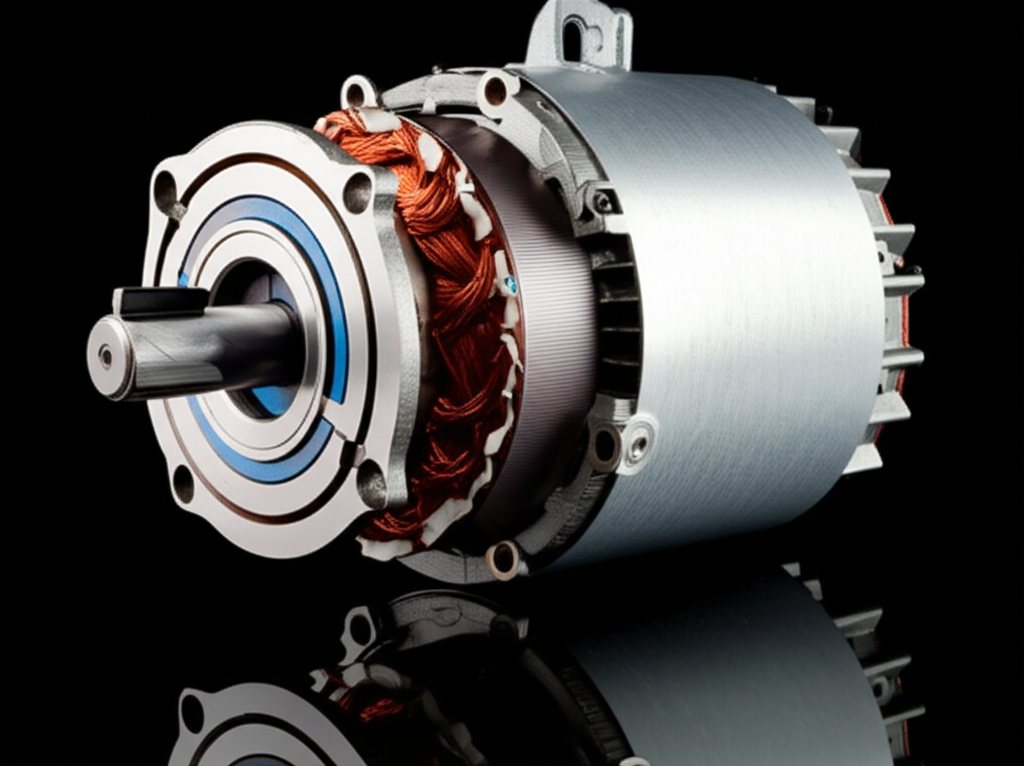
This process is fundamental to creating components for electric machines. For example, in manufacturing a bldc stator core, the magnetic properties of the material are precisely controlled to guide magnetic flux efficiently when the motor is energized.
IV. How Permanent Magnets “Remember” Magnetism: Retentivity & Coercivity
The final and most crucial step in creating a permanent magnet is what happens after you turn off that powerful external field. This is where two key properties come into play: retentivity and coercivity.
A. Retentivity (Remanence): The Ability to Hold Magnetism
For a material to be a permanent magnet, its domains must remain substantially aligned even after the magnetizing field is gone. This ability to retain magnetism is called retentivity, and the strength of the remaining magnetic field is called remanence or residual magnetism.
In an ideal permanent magnet, the domains get “stuck” in their aligned position due to imperfections and stresses within the material’s crystal structure. These imperfections act like pinning sites, making it difficult for domain walls to move back to their original random configuration.
B. Coercivity: Resistance to Demagnetization
Coercivity is arguably the most important property of a permanent magnet. It measures the material’s resistance to being demagnetized by an opposing external magnetic field. A high coercivity means you need to apply a very strong magnetic field in the opposite direction to knock the domains out of alignment and erase the magnet’s field.
This is the key difference between “hard” and “soft” magnetic materials:
- Hard Magnetic Materials: These have high coercivity and high retentivity. They are difficult to magnetize but, once magnetized, they strongly resist demagnetization. These are the materials used for permanent magnets (e.g., Neodymium, Alnico).
- Soft Magnetic Materials: These have low coercivity. They are easy to magnetize and demagnetize. This property is perfect for applications where the magnetic field needs to be switched on and off quickly, like in transformers and electric motors. The electrical steel laminations used in these devices are a prime example of soft magnetic materials, designed to minimize energy loss as the magnetic field rapidly cycles.
C. The Hysteresis Loop: A Material’s Magnetic Fingerprint
Engineers visualize these properties using a graph called a magnetic hysteresis loop, or a B-H curve. This plot shows how a material’s internal magnetic flux density (B) responds to an external magnetizing force (H).
For a permanent magnet, the loop is “fat,” indicating a large area within the curve. This signifies high retentivity (where the curve crosses the vertical axis) and high coercivity (where the curve crosses the horizontal axis). For a soft magnetic material, the loop is “skinny,” showing it can be magnetized and demagnetized with very little energy input.
V. Key Factors Influencing Permanent Magnet Strength and Stability
Not all permanent magnets are created equal. Their performance depends heavily on material composition, manufacturing methods, and operating conditions.
A. Material Composition
The choice of elements is the primary determinant of a magnet’s potential.
Table: Comparative Properties of Common Permanent Magnet Types
| Magnet Type | Primary Composition | Relative Strength (Energy Product BHmax) | Coercivity | Max Operating Temp (Curie Temp Range) | Key Characteristics & Applications |
|---|---|---|---|---|---|
| Neodymium (NdFeB) | Neodymium, Iron, Boron (often with Dysprosium) | Very High (up to 55 MGOe) | High | 80-230°C (310-400°C) | Strongest commercial magnets. Motors, generators, hard drives, MRI, sensors. Prone to corrosion. |
| Samarium-Cobalt (SmCo) | Samarium, Cobalt (often with Iron, Copper) | High (15-32 MGOe) | Very High | 250-350°C (700-800°C) | High temperature stability, excellent corrosion resistance. Aerospace, defense, high-temp motors. |
| Alnico | Aluminum, Nickel, Cobalt, Iron, Copper | Moderate (5-10 MGOe) | Low to Moderate | 450-550°C (700-860°C) | Excellent temperature stability, good corrosion resistance. Sensors, meters, guitar pickups. Brittle. |
| Ferrite (Ceramic) | Barium Ferrite, Strontium Ferrite | Low (1-4 MGOe) | High | 250-300°C (450-460°C) | Low cost, good corrosion resistance. Speakers, motors, magnetic separators, refrigerator magnets. |
| Flexible/Bonded | Ferrite or Rare-earth powder in polymer binder | Very Low (0.6-2 MGOe) | Moderate | 60-120°C (N/A) | Flexible, easily shaped. Refrigerator seals, crafts, signage. |
Rare-earth magnets like Neodymium (NdFeB) and Samarium-Cobalt (SmCo) are the strongest because their unique crystal structures create exceptionally high magnetic anisotropy, which we’ll discuss below, and their specific electron configurations provide a large number of unpaired electrons. Adding elements like Dysprosium to Neodymium magnets helps increase their coercivity and resistance to heat.
B. Manufacturing Process
How a magnet is made profoundly impacts its final properties. Processes like sintering (compressing powder at high temperatures) and casting are used to create a fine-grained crystalline structure. During these processes, a magnetic field is often applied to align the crystallites, locking in a preferred direction of magnetization and maximizing the final magnet’s strength. These processes are essential for creating dense, high-performance magnets that can be assembled into larger magnetic components, such as core lamination stacks.
C. Curie Temperature
Every permanent magnet has a critical temperature limit known as the Curie temperature. Above this point, the thermal energy vibrating the atoms becomes so intense that it overwhelms the quantum exchange interaction. The disciplined alignment of the magnetic domains breaks down into a random, chaotic state. The material loses its ferromagnetism and becomes merely paramagnetic.
Once cooled below the Curie temperature, it can be remagnetized, but its permanent magnetic field is gone. This is a crucial design consideration for any application involving heat, such as electric motors or generators. As the table shows, SmCo magnets excel in high-temperature environments where NdFeB magnets would fail.
D. Magnetic Anisotropy
Magnetic anisotropy describes a material’s preference for being magnetized along a specific crystallographic direction, often called the “easy axis.” Think of it like the grain in a piece of wood—it’s much easier to split the wood along the grain than against it.
In magnet manufacturing, great effort is made to align the crystal grains so their “easy axes” all point in the same direction. This makes the material much easier to magnetize to saturation in that direction and dramatically increases its coercivity, as it takes far more energy to force the magnetization into a “hard” direction. This property is a key reason for the superior strength of modern rare-earth magnets.
VI. Debunking Myths: What Permanent Magnets Are NOT
To complete our understanding, it’s important to clear up a couple of common misconceptions.
- They are not infinitely “permanent.” The term “permanent” is relative. As we’ve seen, a strong opposing magnetic field, significant physical shock, or temperatures above the Curie point can all demagnetize a permanent magnet. They also lose a very tiny fraction of their strength over long periods (years or decades), but for most practical purposes, this decay is negligible.
- They are not a source of perpetual energy. While a magnet’s field can do work (like lifting a paperclip), the energy for that work comes from the force you use to pull the paperclip away from the magnet. The magnet’s field is a static property rooted in its atomic structure; it doesn’t “generate” energy from nothing.
Conclusion: The Enduring Power of the Invisible Force
The magnetism of a permanent magnet is not a single property but the culmination of a remarkable chain of events, starting at the quantum level and scaling up to the object you can hold in your hand.
Let’s recap the journey:
- It begins with the electron spin, which turns individual electrons into microscopic magnets.
- In certain atoms, unpaired electrons create a net atomic magnetic moment.
- In ferromagnetic materials, the exchange interaction provides a powerful quantum force that causes neighboring atoms to spontaneously align their magnetic moments.
- This alignment creates microscopic magnetic domains, which are then oriented by an external field during the magnetization process.
- Finally, high retentivity and coercivity—properties rooted in the material’s crystal structure and composition—allow the domains to remain aligned, creating a strong, persistent magnetic field.
From the atomic dance of electrons in a piece of iron to the precisely engineered crystal structures of a neodymium magnet, the principles of permanent magnetism are a beautiful example of quantum physics manifesting in our macroscopic world. Understanding this science empowers engineers and designers to harness this invisible force, driving innovation in everything from electric vehicles and wind turbines to medical imaging and consumer electronics. The magic, it turns out, is simply brilliant physics.